
-
Innovative Radiopharmaceuticals 2026.08.25 (10:55-11:10) | The Platz Seminar Room VS PharmTech Hoyun Nam, Director Detail View
-
Global Business Expansion Buildup ② - China Market Trend Analysis and Global BD Success Cases 2026.08.27 (13:00 - 16:00) | E1 Seminar Room (Hall E) Korea Institute of Toxicology(KIT), Yafo Capital Fan Zheng, Managing Partner, Execution Detail View
-
K-Bio Modality & Tech Commercialization 2026.08.25 (10:00-10:20) | The Platz Seminar Room 1004 VenturePartners Soyoung Park, CEO Detail View
-
Changes in the Global Clinical Trial Market (Technology, Capital, Regulation) 2026.08.27 (10:00-10:40) | IR Pitching Seminar Room (The Platz Hall) TRIALIGN Consulting Sally Bang, CEO Detail View
-
Malaysia's Regulatory Requirements for Pharmaceutical Product Registration 2026.08.25 (11:30-12:20) l E1 Seminar Room (Hall E) NPRA Zarina Rosli, Senior Principal Assistant Director Detail View
-
RWD-Driven Evidence Lifecycle: From Drug Development to RMP-Based Safety Management 2026.08.27 (11:30-12:10) | The Platz Seminar Room SELTA SQUARE INC. Hyejung Lee, Director Detail View
-
Next-Generation Quantum Drug Discovery Technologies 2026.08.25 (11:10-11:25) l The Platz Seminar Room Quantum Intelligence Corp. Keunsu Choi, Principal Researcher Detail View
-
Innovative TPD Technology 2026.08.25 (10:40-10:55) l The Platz Seminar Room UPPthera Siwoo Choi, CEO Detail View
-
Program Process & Results 2026.08.26 (10:30-10:40) l The Platz Seminar Room KIBO Heonseok Bae, Team Leader Detail View
P-0

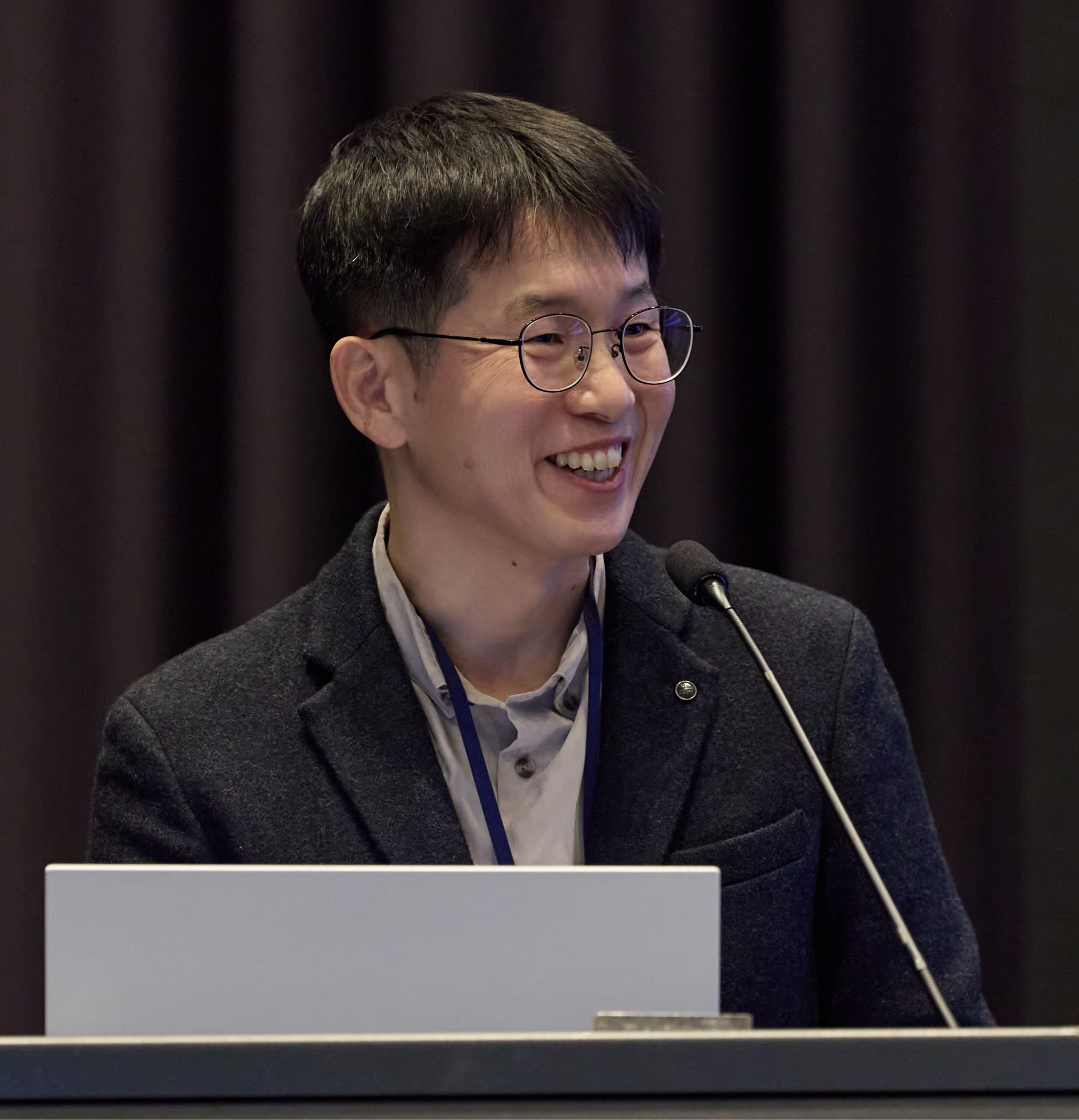
| Title | Next-Generation Quantum Drug Discovery Technologies |
|---|---|
| Date | 2026.08.25 (11:10-11:25) l The Platz Seminar Room |
| Organization | Quantum Intelligence Corp. |
| Speaker | Keunsu Choi, Principal Researcher |
Speaker & Lecture Information
[Brief Introduction of Seminar]
Molecular docking in early-stage drug discovery is, computationally, a problem of finding the optimal combination among an enormous number of possibilities. Combinatorial optimization of this kind is one of the areas where quantum computing is most anticipated to contribute. This talk introduces an approach that recasts the docking problem in graph form so that it can be addressed on a quantum computer.
When the possible pairings between atoms of the ligand and those of the protein binding site are represented as nodes of a graph, and mutually incompatible pairings as edges, docking becomes the problem of finding the optimal set of non-conflicting pairings — a Maximum Weight Independent Set (MWIS) problem. Neutral-atom quantum computers are particularly well suited to this formulation: because neighboring atoms cannot be simultaneously excited, the "no-conflict" constraint is enforced directly by the hardware itself.
The talk also shares practical experience from applying this method to protein–ligand systems, and discusses what is achievable with today's quantum computers as well as the challenges that remain.
[Brief Introduction of Speaker]
Dr. Keun-Su Choi is a Principal Researcher at Quantum Intelligence Corporation (QIC) and serves on the Board of Directors of the Korea Quantum Industry Association, where he leads the identification of industrial use cases for quantum computing, spanning pharmaceutical and biotechnology applications as well as chemistry and materials. In drug discovery, he is investigating the reformulation of molecular docking as a graph optimization problem solved on neutral-atom quantum computers, with application to protein–ligand systems. Dr. Choi received his B.S. and Ph.D. in Physics from Seoul National University, specializing in condensed matter theory. He subsequently held research positions at KIST and UNIST, where over more than a decade he applied quantum-mechanical simulation to elucidate atomic-scale phenomena across energy, environmental, and catalysis applications. He has published more than 40 papers in peer-reviewed international journals.